MY GAME BOY COLLECTION
Here’s the list of all my GameBoy games.
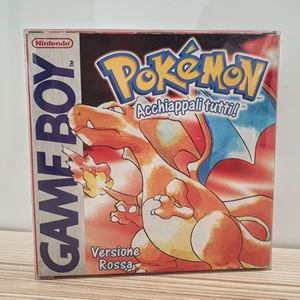
Pokémon Red Version and Pokémon Blue Version are 1996 role-playing video games developed by Game Freak and published by Nintendo for the Game Boy. They are the first installments of the Pokémon video game series. They were first released in Japan in 1996 as Pocket Monsters: Red[a] and Pocket Monsters: Green,[b] with the special edition Pocket Monsters: Blue[c] being released in Japan later that same year. The games were later released as Pokémon Red and Pokémon Blue in North America and Australia in 1998 and Europe in 1999. Pokémon Red and Pokémon Blue combined Red/Green/Blue for release outside of Japan. Pokémon Yellow, an enhanced version, was released in Japan in 1998 and in other regions in 1999 and 2000.
The player controls the protagonist from an overhead perspective and navigates him throughout the fictional region of Kanto in a quest to master Pokémon battling. The goal of the games is to become the champion of the Indigo League by defeating the eight Gym Leaders and then the top four Pokémon trainers in the land, the Elite Four. Another objective is to complete the Pokédex, an in-game encyclopedia, by obtaining the 151 available Pokémon. Red and Blue utilize the Game Link Cable, which connects two Game Boy systems together and allows Pokémon to be traded or battled between games. Both titles are independent of each other but feature the same plot, and while they can be played separately, it is necessary for players to trade between both games in order to obtain all of the original 151 Pokémon.
| ||||
| ||||
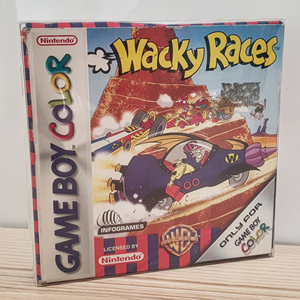
Wacky Races is a racing videogame, developed by Appaloosa Interactive for PC and PlayStation, and by Velez & Dubail for the Game Boy Color, and published by Infogrames in 2000.The games use the story and characters from the American series Wacky Races created by William Hanna and Joseph Barbera. The eleven racing cars compete against each other across circuits inspired by the cartoon. Each vehicle has its own characteristics, strengths and weaknesses, resulting in a wide variety of driving styles. For example, the Army Surplus Special, driven by Sergeant Blast and Private Meekly, has low acceleration but high top speed. The Arkansas Chuggabug, meanwhile, has moderate top speed but very good handling.As in Mario Kart, each competitor has gadgets and weapons to fight their way to first place (such as bubble gum, exploding pumpkins, and land mines). The player must accumulate tokens scattered around the tracks in order to use the vehicle's specific gadgets. These gadgets are divided into three categories: defense, speed and attack. At the end of the championship mode for the first time, the player has access to the Mean Machine owned by Dick Dastardly and Muttley, with superior gadgets. The game has four game modes: Time Trial, Championship, Multiplayer, and Super Gadgets. The latter offers a detailed list of all the gadgets available in the game. | ||||
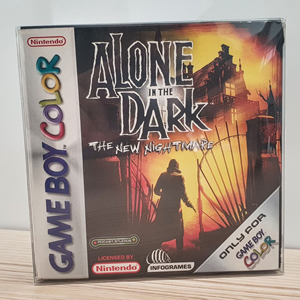
Alone in the Dark: The New Nightmare , alternatively known as Alone in the Dark 4, is the fourth installment and first reboot of the survival horror video game series Alone in the Dark, developed by Darkworks and published by Infogrames Entertainment, SA.[3] The game was released in 2001 on several platforms including Microsoft Windows, PlayStation, Dreamcast, and Game Boy Color. A PlayStation 2 version of the game was also released several months after and only in Europe. Plot: Set on October 31, 2001. Edward Carnby's best friend and partner, Charles Fiske, has been found dead off the coast of Shadow Island, a mysterious island near the coast of Massachusetts. Carnby's investigation quickly leads him to Frederick Johnson, who informs him of Fiske's search for three ancient tablets with the ability to unlock an incredible and dangerous power. Johnson pleads with Carnby to take the place of Fiske and reopen the investigation in order to recover the tablets. Carnby accepts and makes it his mission to find Fiske's killer. Johnson introduces Edward to Aline Cedrac, an intelligent, young university professor. She joins Edward to recover the missing tablets and assist Professor Obed Morton, whom she believes to be her father. While flying over the coast of Shadow Island, Edward and Aline's plane comes under attack by an unknown creature. Edward and Aline both jump out of the plane and parachute to the ground, but are separated immediately. Edward lands in the dense forest just outside a manor, while Aline lands on the roof of it. The game's plot is a separate canon from the main of the series. Gameplay: The player is given the option of choosing which of the two protagonists they play as. Carnby's side of the plot is based mainly on fighting the monsters by physical means, particularly with his trusty double barreled revolver; while Aline's is more centered on puzzles. The two occasionally meet up, and the main areas of plot intersect. The player soon comes under attack from Creatures of Darkness that appear out of nowhere and seem to be living shadows. These Creatures of Darkness are eventually revealed to be reptilian, silicon-based life forms from the center of the Earth, an enormous world of dark caverns known as the World of Darkness. Shadow Island apparently contains one of the many portals to this underground world. True to their name, the game's enemies are averse to light (which apparently turns them into ash), and this figures heavily in gameplay. Players can use their flashlight to repel certain creatures, and killing them is accomplished with such light-producing ammunition as "magnesium bullets" and "phosphorus shells." Light plays a significant role in this game. One of the game's main features is the flashlight that can be used to light up the game's darkened scenes, revealing hidden details and uncovering items. To this end, the developers crafted an unusual graphics engine which allowed the 3D player character's flashlight to properly illuminate and cast shadows on the 2D, pre-rendered backdrops. This was accomplished by rendering the backdrops at various levels of illumination and including information on the distribution of objects in the scene. The graphics engine could then properly use brighter versions of the backdrop where the flashlight was expected to be casting light, and leave shadowed areas dark. | ||||
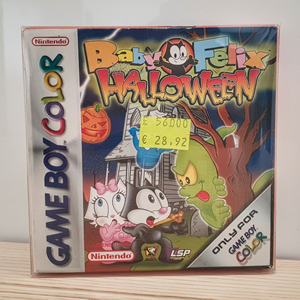
Baby Felix Halloween is a 2001 Game Boy Color game developed by Bit Managers and published by Light & Shadow Productions, and is based on the Baby Felix and Friends show, starring Felix the Cat in his infant form. Baby Felix and his ladyfriend Kitty Cat go out trick or treating on Halloween, night, but get lost along the way. They stumble across an abandoned house, and they are given a warning from someone inside of it that Felix has to save his friends, who also got lost that night and are trapped inside the mansion. The game is a staple platformer, and gives you the option of playing between Baby Felix and Baby Kitty Cat (although they both play identical aside from cosmetic differences). Your goal is to get through each linear level and rescue Felix's friends one by one while fighting enemies along the way. | ||||
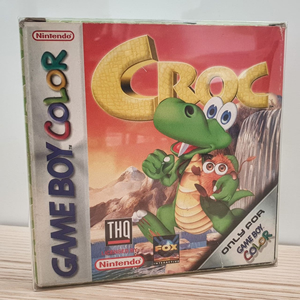
Croc Deluxe. is a 2000 platform game developed by British studio Virtucraft and published by THQ under license by Fox Interactive and Argonaut Games for the Game Boy Color. It is a remake of the 3D platform game, Croc: Legend of the Gobbos, and features similar gameplay taking place in a 2D environment. The game follows the eponymous character, a crocodile named Croc, as he sets out on a quest to save a race of furry creatures called Gobbos from the evil Baron Dante. The game was released on 6 June 2000 to mixed reviews from critics. Croc is a 2D side-scrolling platformer in which the player controls a green crocodile named Croc who sets out on a quest to rescue the Gobbos from the evil Baron Dante. The player controls Croc through a series of various short levels, each accessed through a top-down world map. The main goal of each level is to progress through to the end of the stage and hit the gong at the end of the level in order to progress to the next. Certain levels also involve defeating a boss in order to progress to the next stage. Numerous collectibles are scattered throughout levels, such as blue crystals that act as Croc's health as well as giving the player an extra life when 100 of them are collected, small hearts that also give the player an extra life, and crates containing items that can be broken apart. Each level contains 3 captured Gobbos which are hidden throughout the stage in various locations. Also located throughout every stage are 5 multicolored letters spelling out the word "bonus"; collecting all of these letters unlocks a door located at the end of the stage leading to one of several minigames that can be played in order to win a fourth Gobbo, including a slider puzzle, a Whac-a-Mole-esque game, a catching game in which the player moves a bowl back and forth in order to collect various falling items, and a slot machine game. Collecting every single Gobbo in each level before a boss level unlocks a secret level containing a hidden Jigsaw puzzle piece. While collecting all of these pieces is not mandatory for completing the game, collecting every Jigsaw piece in the game unlocks a fifth world filled with secret levels, and is the only way to reach the game's final boss. | ||||
NBA All-Star Challenge 2 is a basketball game with six mini games, mostly based on real-life one-on-one variants. The main differences to the predecessor are the new mini game Slam Dunk (replaces H.O.R.S.E.) and slightly reworked graphics for the others. Before each game, the player can choose between 27 real-life athletes, one from each NBA team's 1991 roster. All games can be played by two players via the Game Boy link cable. 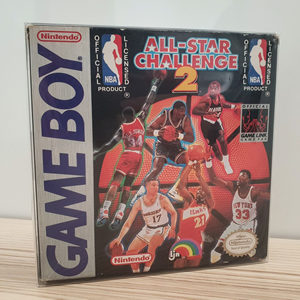
| ||||
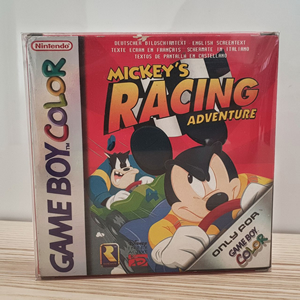
Mickey's Racing Adventure centers around isometric racing challenges in various worlds. The story begins as everyone in Mickey's home town was getting prepared for a big carnival, with Professor Ludwig Von Drake showing off his new floats to Mickey, Minnie, and friends. However, Big Bad Pete, watching from his creepy mansion, gathered his cronies to swipe all the decorations, leaving only a letter challenging the group to a race to get their things back. | ||||
|
|
HOME |